About the Blog

I shall post videos, graphs, news stories, and other material. We shall use some of this material in class, and you may review the rest at your convenience. I encourage you to use the blog in these ways:

--To post questions or comments about the readings before we discuss them in class;
--To follow up on class discussions with additional comments or questions.
--To post relevant news items or videos.

There are only two major limitations: no coarse language, and no derogatory comments about people at the Claremont Colleges. This blog is on the open Internet, so post nothing that you would not want a potential employer to see.

Tuesday, September 21, 2021

Goals and Policy Initiation

 FOR THURSDAY, READ DOWNS, "THE ISSUE-ATTENTION CYCLE."

Framing:


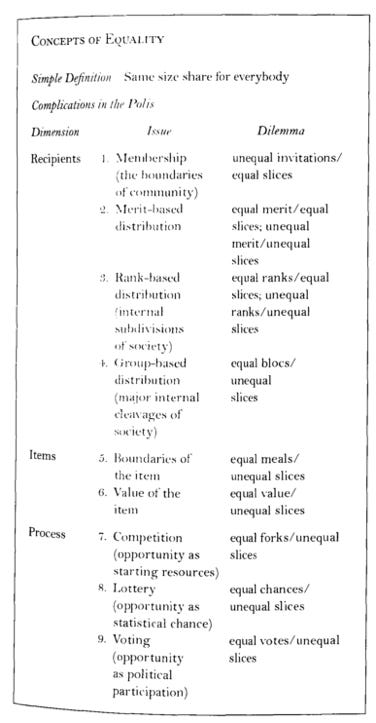
Equity and Equalities (Stone, ch. 2)


EFFICIENCY:  AT WHAT?  FOR WHOM?

WELFARE AND NEED
  • Maslow
  • Relative and Absolute
  • Quality of Life Measures, disability and terminal illness
LIBERTY AND SECURITY


SO HOW DO ISSUES ENTER THE AGENDA?


Thursday, September 16, 2021

Markets and Public Policy

WRITING ASSIGNMENT

NEXT WEEK, WE DISCUSS GOAL-SETTING AND POLICY INITIATION.  READ STONE 2-6 FOR TUESDAY, THE DOWNS ARTICLE FOR THURSDAY.

MORTGAGES, MORAL HAZARD. AND INFORMATION ASYMMETRY

RATING AGENCIES

DODD-FRANK REFORMS AND ... UNINTENDED CONSEQUENCES.


COMPETITION
  • "CROWDING OUT"
  • OTHER FORMS OF GOVERNMENT/MARKET COMPETITION
COMPETITION AMONG AGENCIES AND LEVELS OF GOVERNMENT:  FEATURE OR BUG?
INTEREST AND POLITICS (SCHUCK, P. 216)

FROM JQ WILSON, THE POLITICS OF REGULATION


REGULATORY CAPTURE AND IRON TRIANGLES


Wednesday, September 15, 2021

First Assignment, Fall 2021

 Choose one:

1. See page 57 of Stone, and undertake the exercise that she suggests in the passage that starts “When you confront a political issue…” and ends with “read between the lines and interpret.” Pick a current policy issue, and identify two political figures who take different positions. “Read between the lines” and infer their answers to Stone’s questions.

2. Fifty years ago, Max Singer wrote a landmark article titled “The Vitality of Mythical Numbers.” Write your own version about a current issue. That is, identify a dubious statistic that features prominently in policy debate, carefully explain why it is problematic, and spell out how it has distorted deliberations over the issue. 

3.  After reading the Downs essay on the issue-attention cycle, take an issue from recent years (not including COVID), and explain how it progressed through the cycle.

Instructions:
  • Document your claims. Do not write from the top of your head.
  • Essays should be double-spaced and no more than four pages long. I will not read past the fourth page.
  • Cite your sources with endnotes in Chicago/Turabian style. Endnote pages do not count against the page limit.
  • Watch your spelling, grammar, diction, and punctuation. Errors will count against you.
  • Turn in essays to the class Sakai dropbox by 11:59 PM, Friday, October 1. I reserve the right to dock late essays one gradepoint for one day’s lateness, a full letter grade after that.

Tuesday, September 14, 2021

Incentives, Disincentives, Expections


POLICYMAKERS
  • ELECTEDS:  Reelection, institutional power, good public policy
  • BUREAUCRATS: Job security, professional and organizational loyalty,good public policy
CITIZENS

AFFECTED PARTIES

MISMATCH OF INCENTIVES AND DESIRABLE OUTCOMES:
  • COLLECTIVE GOODS
  • COLLECTIVE ACTION
  • TIME HORIZONS

MORAL HAZARD

[One] moral hazard that contributed to the financial crisis was the collateralization of questionable assets. In the years leading up the crisis, it was assumed lenders underwrote mortgages to borrowers using languid standards. Under normal circumstances, it was in the best interest of banks to lend money after thoughtful and rigorous analysis. However, given the liquidity provided by the collateralized debt market, lenders were able to relax their standards. Lenders made risky lending decisions under the assumption they would likely be able to avoid holding the debt through its entire maturity. Banks were offered the opportunity to offload a bad loan, bundled with good loans, in a secondary market through collateralized loans, thus passing on the risk of default to the buyer. Essentially, banks underwrote loans with the expectation that another party would likely bear the risk of default, creating a moral hazard and eventually contributing to the mortgage crisis. 


TRUST AND CREDIBILITY


Thursday, September 9, 2021

Structure and Political Culture (or, Gov 20 Redux!)

 For Tuesday, read Schuck, ch. 5-6.

Which instrument?  "A policy may be cost-ineffective because it uses the wrong tool" (Schuck, 54).


Some problems with various instruments:
  • Equity
  • Accountability (e.g., DeJoy)
  • Information, Disinformation, Misinformation, and Persuasion
  • Direct expenditure cost
  • Unanticipated consequences, "invisible victims"
  • Legal authority of the level of government

Which leads to DECENTRALIZATION (Schuck, 95)
  • 1 federal government
  • 50 states
  • 3,301 counties
  • 35,748 cities, towns, and other general-purpose governments
  • 51,296 special-purpose governments (e.g., school districts)
  • For a total of 90,126 US governments  (even more if you count Puerto Rico,  Guam, American Samoa, US Virgin Islands, and Northern Mariana Islands)

But wait, there's more!
  • Bicameralism and separation of powers
  • Plurality in the executive
    • Independent regulatory commissions at the federal level
    • Statewide elected officials (see California and Texas
  • Citizens as policymakers: initiative and referendum
What is political culture?


  • Religion and Moralism


Tuesday, September 7, 2021

Success and Failure, Outputs, Outcomes, and Instruments

For Thursday, read Schuck, ch. 4 and email me your brief (250 words max) reflections.

What is success?  What is failure?

The public has mixed views of government performance.

Decentralization -- more on Thu

Output and Outcomes

Outputs

                Outcomes

Output is what the activity creates at its end.

Outcome is the level of performance that occurred because of the program.

Outputs are immediate products.

Outcomes are results that may take months or years.

Outputs are easy to measure (e.g., payments)


Outcomes are usually hard to measure.

Outputs are within direct control of the managers.

Outcomes are not within direct control of the program/program managers.


Some outputs of a HIV/AIDS program:

  • Number of HIV/AIDS workshops and  participants
  • Number of prophylactics sent out.
  • Number of community awareness meetings

Some outcomes:

  • Increased knowledge of HIV/AIDS
  • Increased treatment success
  • Decreased incidence and prevalence


The distinction is not always airtight.  UC administrators and students may have very different ideas about what counts as an outcome:

It is both common and controversial:  see issues of race and disability.

Instruments of policy (abbreviated from Schuck 80-83):

Thursday, September 2, 2021

Market and Polis

Why public policy scholars need to know a bit of everything.


 For Tuesday, read Schuck, ch. 1-3.

Both economics and politics deal with problems of scarcity and conflicting preferences. Both deal with persons who ordinarily act rationally. But politics differs from economics in that it manages conflict by forming heterogeneous coalitions out of persons with changeable and incommensurable preferences in order to make binding decisions on everyone. Political science is an effort to make statements about the formation of preferences and nonmarket methods of managing conflict among those preferences; as a discipline, it will be as inelegant, disorderly, and changeable as its subject matter.

-- James Q. Wilson, The Politics of Regulation

From Stone:                Market Model            Polis Model

Unit of Analysis

Individual

Community


Motivations

Self-interest 

(paradox of voting)

Altruism & self-interest 


Public Interest

Sum of individual Interests

Shared, community interests (inc. future generations)


Chief conflict

Self-interest v. self-interest

Self-interest v. public interest (commons problems, externalities)


Source of ideas & preferences

Self-generation

Influences from others & society


Nature of social interaction

Competition


Cooperation & competition

Criteria for individual Decision

Max gain, min. cost

Loyalty, group interest, public interest


Building blocks of social action

Individuals

Groups & organizations


Nature of information

Accurate, complete, available

Ambiguous, interpretive, incomplete, manipulated


How things work

Laws of matter

Laws of passion (human resources are renewable & expandable)


Sources of change

Market exchange

Ideas, persuasion, alliance, pursuit of power, self-interest and public interest